How AI is changing both sides of tourism.
A companion to Janette Roush's keynote at the 28th annual American Indigenous Tourism Conference. Your guests are using AI to discover what to do, and AI can help every team with a limited budget do its work. Everything here comes from the recording of the talk and the slides on screen.
Click between the two views.
Even if you decide AI is something you won't use yourself, your guests and visitors are using it to discover experiences and plan their trips. At a minimum, it helps to understand what they see and get ready for them.
Nobody has as much staff or as much money as they'd like. AI can help you do your job better or faster, and make time for the work you enjoy doing.
Real searches Janette ran before coming to Tulalip, and what each one means for a tribal tourism business or destination.
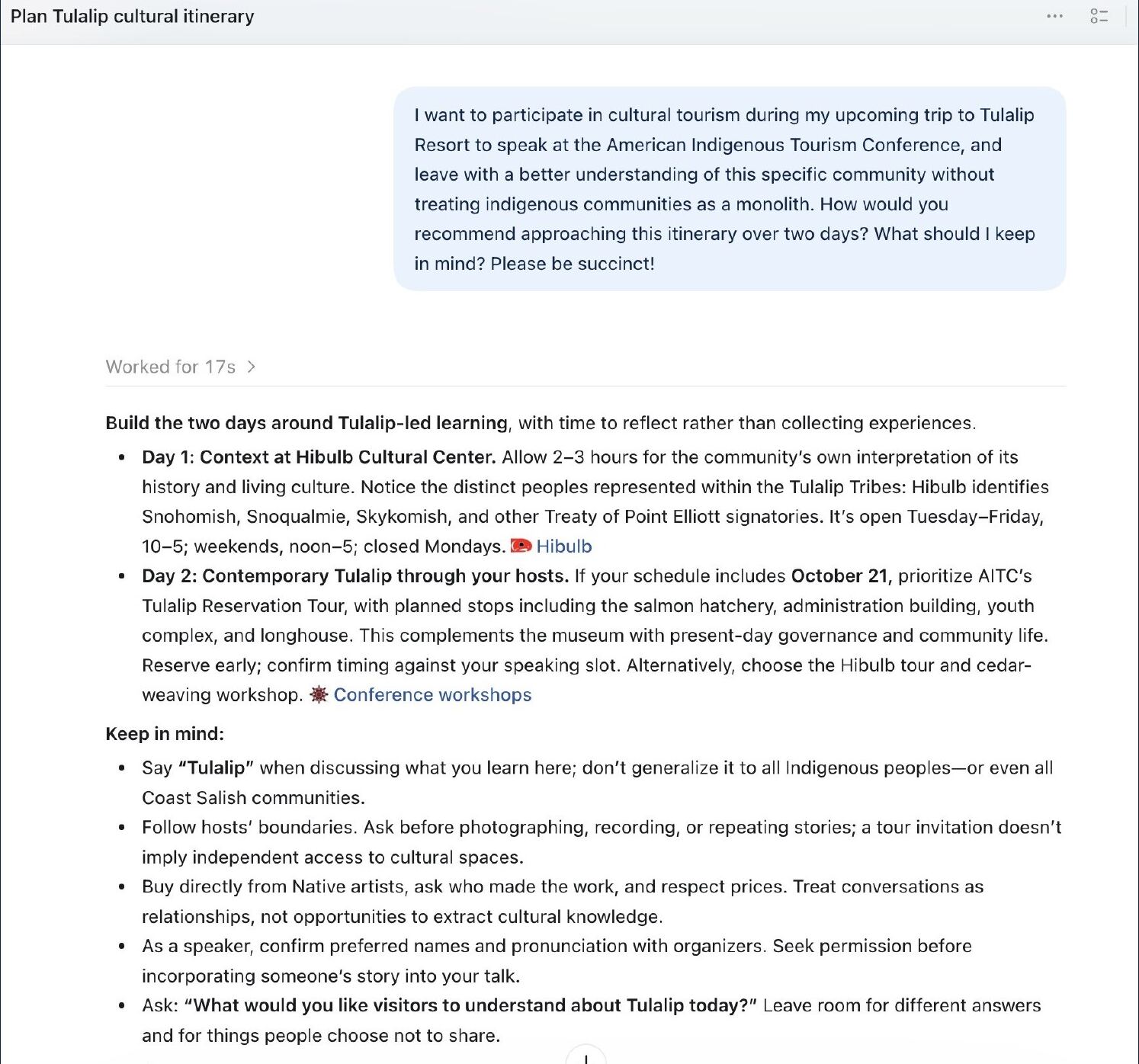
Janette asked ChatGPT how she and her husband could take part in cultural tourism at Tulalip, and understand this specific community without treating Indigenous communities as a monolith.
The answer built two days around the Hibulb Cultural Center and the conference's own Tulalip Reservation Tour. Travelers are asking these questions in a chat window right now, and the answer draws on whatever it can find about you.
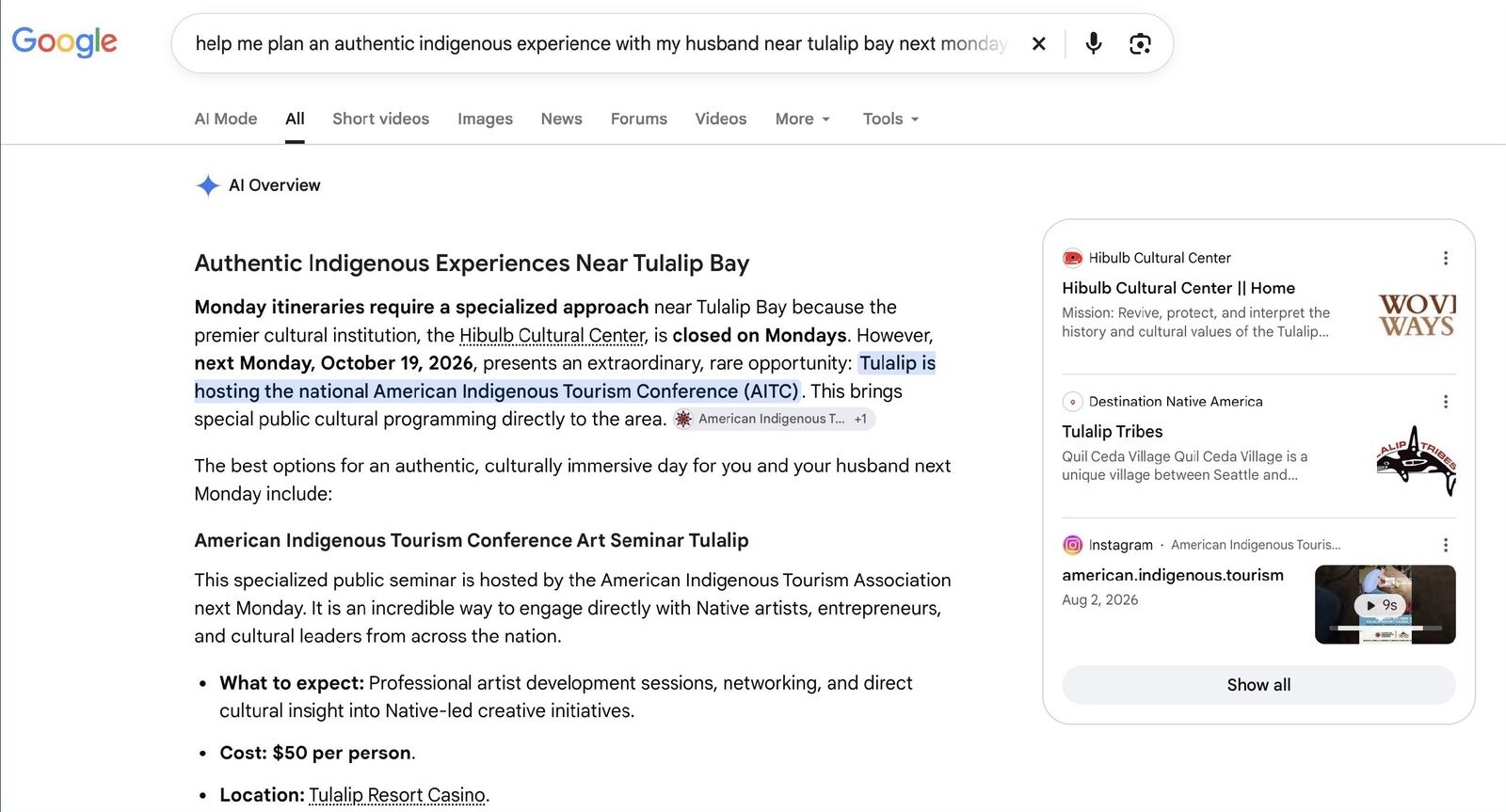
Google's AI Overviews are reducing traffic to our websites. People read the overview, get the information they were searching for, and often don't need to click through to your landing page.
ChatGPT now runs apps inside the chat. Ask about airfares or hotel prices, and it connects to Expedia or Booking.com to bring live prices into the answer.
Meta's Muse is an AI agent that connects to your email, and to Facebook and Instagram. Janette asked it to find a car service from the Memphis airport to Oxford, Mississippi. The first company's website blocked bots. Muse tried three times, gave up, and booked with a second company whose online form it could fill out.
"You are invisible to those people if you are invisible to their agents."
Janette's bet: we will all use AI systems that live on our phones. Maybe a small language model runs locally, so nobody shares data with a third party. Your content has to be ready for that assistant too, on your website and off it.
The same top-ten restaurant list is everywhere, so AI has no reason to quote yours. The details that live only in your staff's heads are what these tools look for. Write those down.
Skip anonymous articles. Interview your CEO and put their byline on the piece. A named person with an opinion and a point of view tells AI systems a human crafted this content.
People add "Reddit" to their searches to hear from real people, and AI looks for the same outside voices. Press coverage of your tribe, your experiences, and your business gives AI more pointers back to your own content.
Do you still need a website? Absolutely, a hundred percent yes. Fewer people are coming to websites than ever, and the people who do come need a place where all of your content lives. AI is becoming the distribution channel for your content, so it needs one owned space to use as a reference.— JANETTE ROUSH
A short checklist from the talk. Click each step as you finish it; your progress stays in this browser.
The biggest single tip. Claim it and keep it current at Google Business Profile.
Bing Places, Apple Business Connect (Apple Maps), and Yelp for Business. When every listing carries the same hours and details, AI reads that as a sign a person keeps the information up to date.
Make it easy to find for people and for machines.
Type /robots.txt after your web address. The file lists which sites may visit and which are blocked. See whether AI crawlers are on the blocked list, so whatever they can read is your decision. Paste what you find into your favorite AI tool and ask it to explain what the file says and how to interpret it.
You already add alt text so someone who is blind or low-vision knows what a photo shows. Structured data does the same for the facts on your site, so a machine understands them instantly. Your web company or agency can help.
Before paying anyone for an audit, search ChatGPT, Claude, and Google yourself. Learn the baseline for your business or cultural attraction.
User-agent: *
Allow: /
User-agent: GPTBot
Disallow: /
The top rule welcomes every visitor. The bottom rule shuts out ChatGPT's crawler. A "page not found" means nothing is blocked. If you see Disallow, talk with whoever runs your website about what you want AI to read.
"openingHoursSpecification": {
"dayOfWeek": ["Tuesday", "Wednesday",
"Thursday", "Friday"],
"opens": "10:00",
"closes": "17:00"
}
The same fact, twice. With structured data, an assistant gets your hours directly, without guessing.
Want to check your own site? Try the free audit tool from the talk. Paste in your page's code to see its schema, headers, and other signals AI reads.
There are real issues with environmental effects and with data ownership when we use AI at work. These four questions help you decide whether something is a good project for AI at all. Click each one.
The four questions follow the CARE Principles for Indigenous Data Governance: Collective benefit, Authority to control, Responsibility, and Ethics. Global Indigenous Data Alliance, 2019.
Staff will use AI tools whether or not your organization has a policy. When that use happens privately and goes unreported, the organization takes on risk it cannot see, and IT loses visibility into where private data goes.
Clear guidelines define what is permitted and what is not, so staff can use AI with confidence rather than uncertainty. Use the four questions as the framework for writing it.
"You're going to drive the car a little bit faster when you know where the brake pedal is."
Many of the concerns we have about AI are really about free AI. A free version of ChatGPT can use what you put into it to train the next version. You don't want that with confidential business information.
A business account lets you switch training off. It also keeps chat history with the organization when someone leaves. You don't let people keep their email address or their file-server login when they go.
If you have concerns, the AI Resist List is a rich resource for taking a stand on issues like data centers.
Each step is more ambitious than the last: a task, a tool, a process, and an institution. Click through them in order.
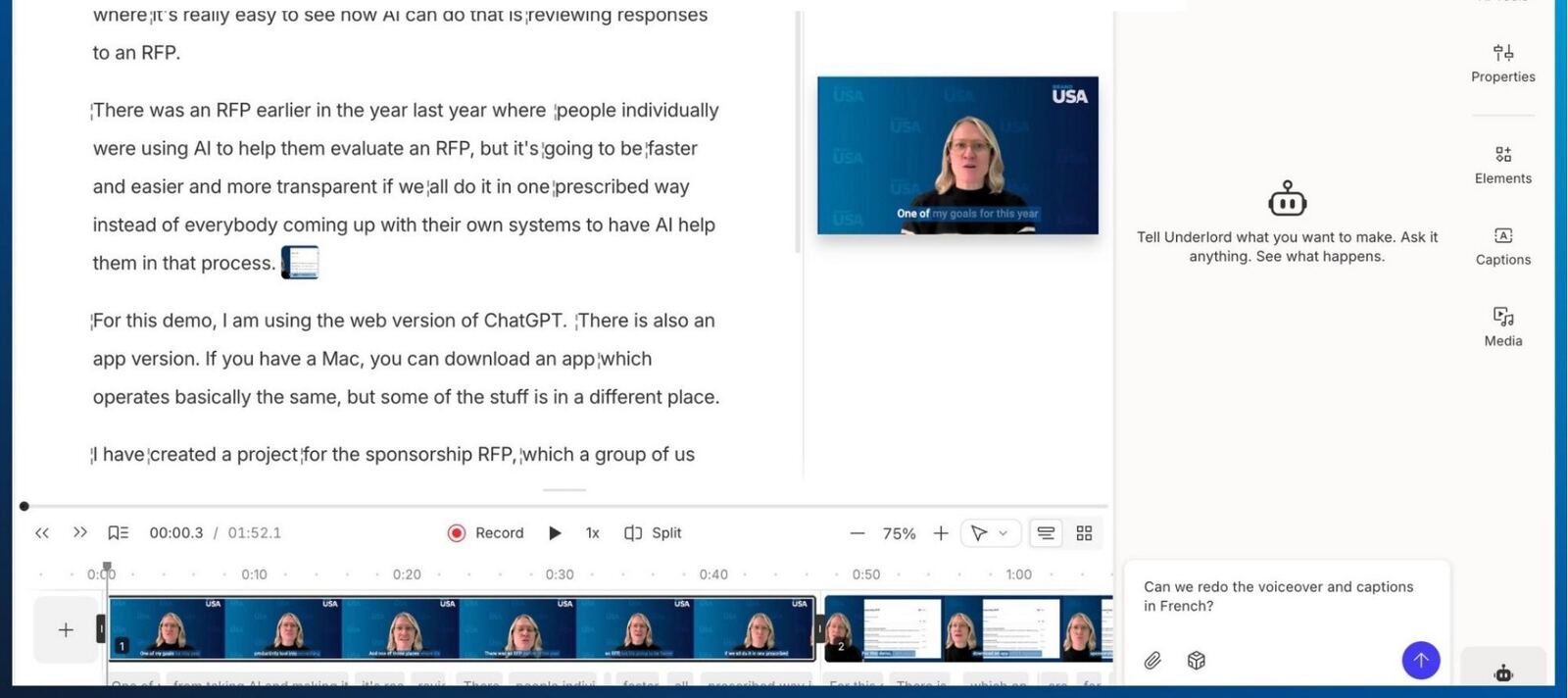
Descript puts the transcript beside the video. Delete words from the transcript and they disappear from the video. Janette uses it to cut the "so" that starts nearly every sentence she says.
Brand USA's travel trade team trains international travel agents and tour operators. The person who runs the South America team knows not every partner has a Spanish speaker on staff, so she puts their videos into Descript. It creates Spanish captions and can add a Spanish voiceover.
Keep a human in the loop. The French version came out with a French Canadian accent, and it took a colleague who speaks French to flag it as a Montreal accent.


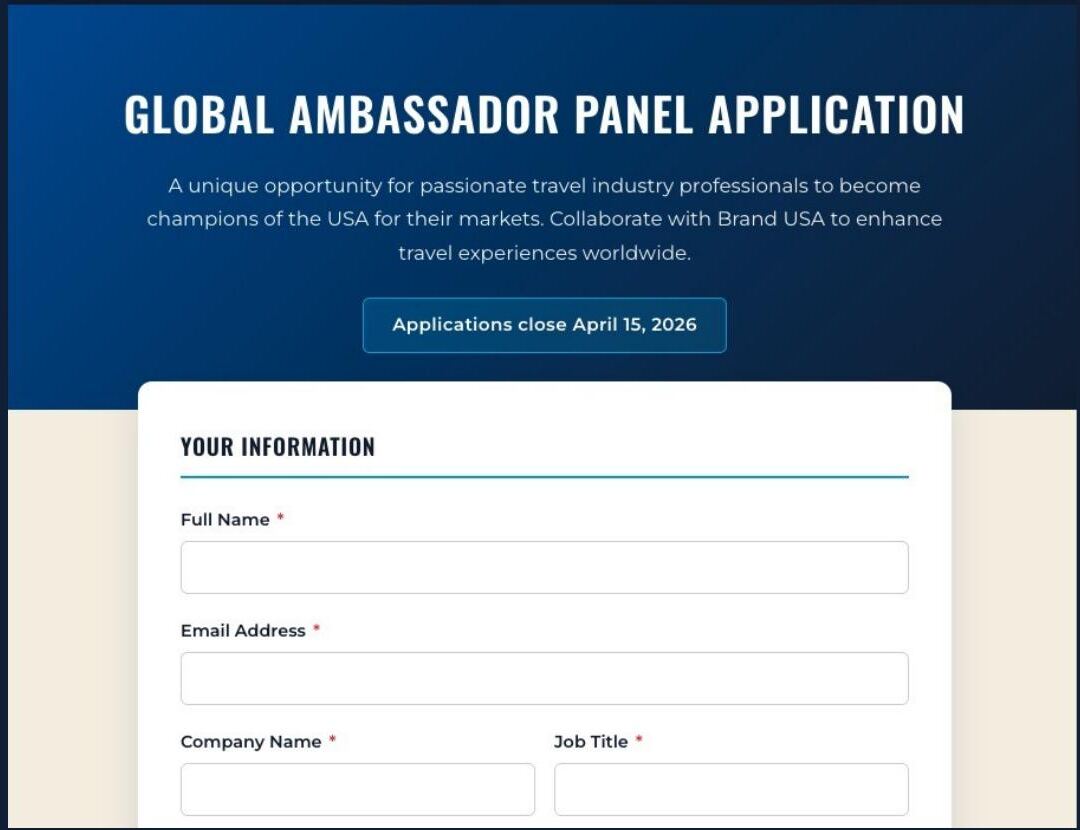
To celebrate America250, Brand USA invited 250 international ambassadors: travel advisors with their own following, identified by its 15 international offices. Each one applied through a form.
The plan was a plain Google Form, with emails collected and forwarded by hand. Someone on the travel trade team said it could look more professional. Claude's answer: keep the Google Form as the back end and build a website on the front. A Google Sheet collects every entry, sorts it by the office that reviews it, and emails that office automatically.
Janette was a theater major who moved to New York to work on Broadway, with no technical training. Everything she showed is something you can build too.

Brand USA now records its planning conversations and builds the strategy as a website. A web page grows or shrinks to fit the content, so a big strategy and a small one each get the space they need, all wiki-linked in one place. After each meeting, the transcript updates the site, so it stays a living document.
A Plaud pin recorded this talk, and this site was built from that transcript and the slides.
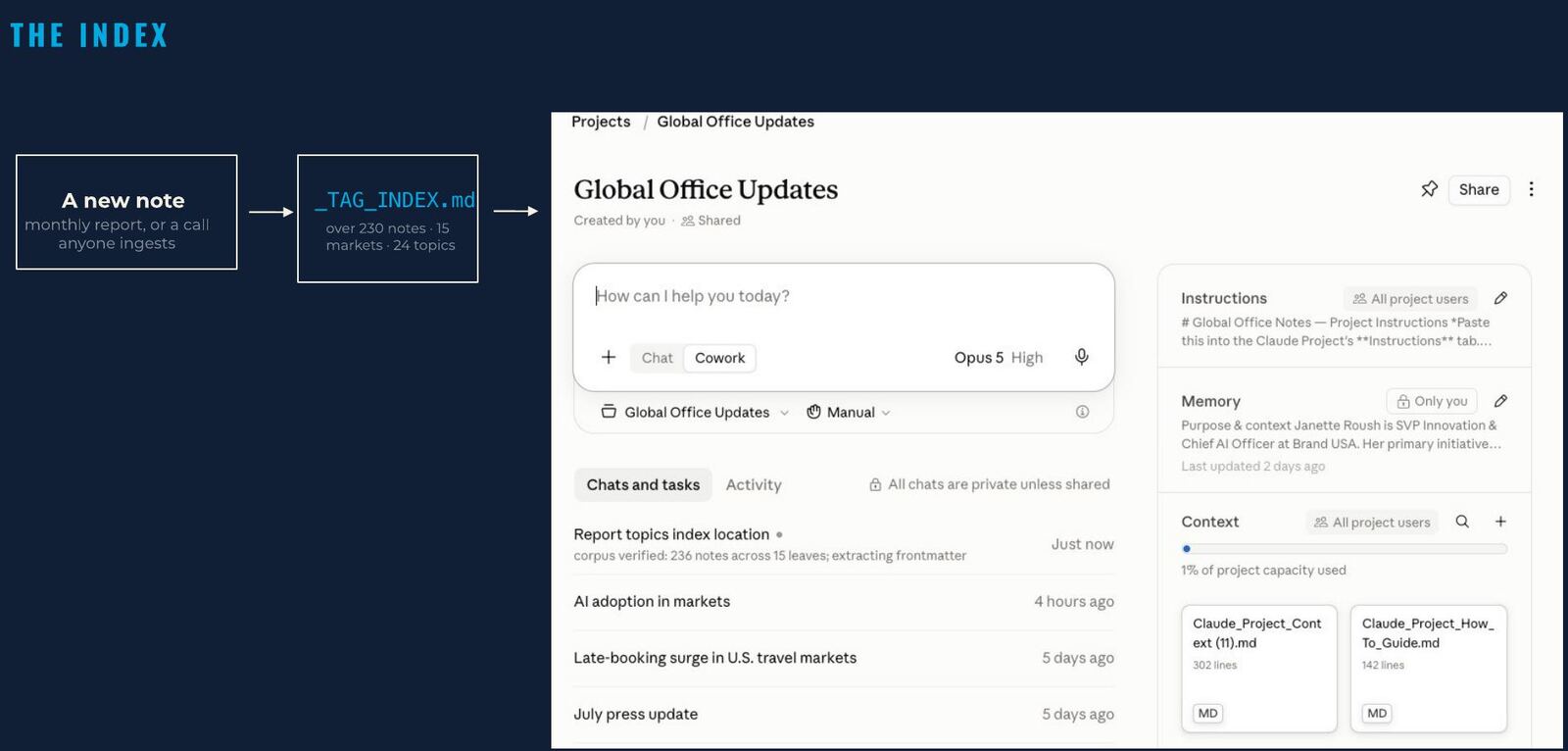
Brand USA's 15 international offices each save a monthly PDF report in Box, meet with the team every two weeks, and present to the C-suite once a quarter. Before, answering a question like "do the offices ever mention travelers using AI?" meant messaging five colleagues or reading every report by hand.
Janette connected Claude to Box. It reads only what she has access to, so it can't pull up the payroll. It found where every report lived and built an index. A shared Claude project points to that index, so the whole travel trade team can ask questions and follow links to the source reports. The answer can come back as a slide, an executive summary, an email, or a PDF.
The model comes from Y Combinator, where all the information sits in the center and people pull from it or feed it. The same idea works for a conference: one place where all your conference information lives.

AI extends the value of work people already do, and it leaves more time for the parts they enjoy. For Janette, that means being where her feet are: at a conference, in the breakout sessions.
AI for the sake of AI checks a box. The goal is the work we are all here to do, and AI can help you do more of it.
A business account lets you switch off training, which keeps your data private, and keeps chat history with the organization when people leave.
ChatGPT Business and Claude Team list at $25 per person a month on monthly billing (US, October 2026); annual billing costs less.
Pick one weekly task and try it there first. Even if it doesn't work today, it may work in a week or a month.
There is no perfect use case. There's getting used to working with these tools now.
Nobody from OpenAI, Anthropic, or Google is coming to tourism conferences with a guidebook for how AI works in our industry. We build it together by sharing what we learn.
With a paid, secure account, AI is a tool for doing good work responsibly. Many of us are stewards of public funding, and it helps us spend that money as wisely as we can.